
Working Remotely from Spain After Brexit: Alicante or Murcia for UK Professionals?


The old picture of a British expat in Spain usually involved retirement.
That picture is changing.
More UK professionals now want to keep their career while changing where they live.
Laptop open in Alicante.
Morning walk beside the Mediterranean.
A UK salary or international client base.
Home in Spain.
Research published by Idealista in 2026 points to a younger profile of British movers, with working-age professionals playing a larger role than the traditional retiree image suggests. (source)
For remote workers, Alicante and Murcia offer two different ways to make that move work.
Brexit changed how remote workers move to Spain
A British passport alone no longer gives you the right to move to Spain and work there indefinitely.
Short visits fall under the Schengen 90-in-180-day system.
Living in Spain while working remotely requires the appropriate legal route. (source)
Spain's Digital Nomad Visa provides one route for qualifying non-EU remote workers.
The Spanish Consulate in London describes it as a residence visa for people who work remotely for companies or employers outside Spain through digital and telecommunications systems. (source)
Applicants must meet professional, employment or self-employment, financial and documentation requirements.
For employees, the work must be for companies outside Spain. Self-employed applicants have some flexibility to work with Spanish companies, provided that Spanish activity does not exceed 20% of their total professional activity. (source)
Do not confuse the digital nomad route with the retirement route
Spain's non-working residence visa is exactly that.
Non-working.
The London Consulate states that the route does not constitute permission to carry out work or professional activity. (source)
If you intend to keep your UK job or continue freelancing while living in Spain, immigration planning needs to happen before the property search becomes serious.
Your property brief changes when the home is also your office
A holiday-home buyer looks at the terrace.
A remote worker should also look at the room behind it.
Do you have somewhere quiet to work?
Is there space for two desks if your partner works remotely too?
What is the internet connection like?
Does the bedroom sit directly beside a busy road?
How much afternoon sun hits the office?
Is there air conditioning where you will spend the working day?
Is the building quiet enough for video calls?
That spare bedroom might bring more value to your everyday life than a larger swimming pool.

Why Alicante works for connected professionals
Alicante's main advantage is not only the beach.
It is connectivity.
Alicante-Elche Airport served almost 20 million passengers across 228 routes in 2025, with Britain one of its leading international markets. (source)
For someone working internationally, that matters.
You might live in Spain but still need a London meeting.
Clients might visit.
Your company might run quarterly team days in Britain.
Family remains back home.
Access to a major airport makes that hybrid life easier.
Alicante also offers genuine city living
Remote workers do not always want a resort.
Alicante itself gives you an urban centre beside the sea.
Postiguet Beach sits close to the centre and Santa Bárbara Castle, while the wider city offers markets, restaurants, neighbourhoods and other beaches such as San Juan. (source)
That combination suits someone who wants to finish work at five or six and still have plenty happening around them.
The trade-off is price.
Alicante city asking prices reached roughly €2,721 per square metre in August 2026, while asking rents averaged €13.9 per square metre. (source)
Why Murcia works for space-first remote workers
Murcia creates a different opportunity.
Across the region, average asking prices sat around €1,681 per square metre in August 2026, while average rents were around €9.6 per square metre. (source)
Those are regional averages, not a promise of what every property costs.
But the difference changes what your budget might buy.
In Alicante, your budget might lead to a two-bedroom apartment.
In parts of Murcia, the same budget might put a townhouse, larger apartment or home with greater outdoor space into the conversation.
For a remote worker, that extra room has practical value.
A separate office.
A guest room.
A garden.
Space to work without turning the dining table into permanent office furniture.
Coastal Murcia gives you more than cheap square metres
Do not reduce Murcia to a budget option.
The Mar Menor and Costa Cálida offer a lifestyle that works especially well for someone whose commute is ten steps from the bedroom.
Los Alcázares, San Pedro del Pinatar and San Javier provide coastal living without needing a major city outside the window.
Cartagena gives you a stronger urban option.
Murcia city gives you a working Spanish city rather than a tourist-led environment.
British demand is already established. UK users lead foreign property-search interest in Murcia according to Idealista's 2026 analysis. (source)
The airport trade-off matters
Murcia International Airport handled around 949,000 passengers across 23 routes in 2025. Its international traffic remains strongly linked to Britain and Ireland. (source)
That is useful.
It is still a much smaller network than Alicante.
If you expect to fly frequently, check the routes you use rather than assuming the nearest airport solves everything.
Some Murcia residents also use Alicante Airport for its larger network.
Think about UK working hours
Spain is only one hour ahead of the UK for most of the year.
That makes it far easier for British remote workers than moving several time zones away.
Your 9 a.m. UK meeting becomes 10 a.m. in Spain.
You still finish at a reasonable time.
Your colleagues remain reachable throughout the day.
That simple one-hour difference makes Spain practical for employees who need to stay aligned with a UK-based team.
Renting first makes sense for some remote workers
If this is your first long-term move abroad, renting gives you time to learn your working routine before buying.
Kyero specifically positions renting as a way to test expat life before committing to property ownership. (source)
You might discover that you need city life.
You might realise you care more about a garden.
You might decide that being close to Alicante Airport matters less than expected.
Or you might spend three months beside the Mar Menor and know that you have found home.
That information is worth something.
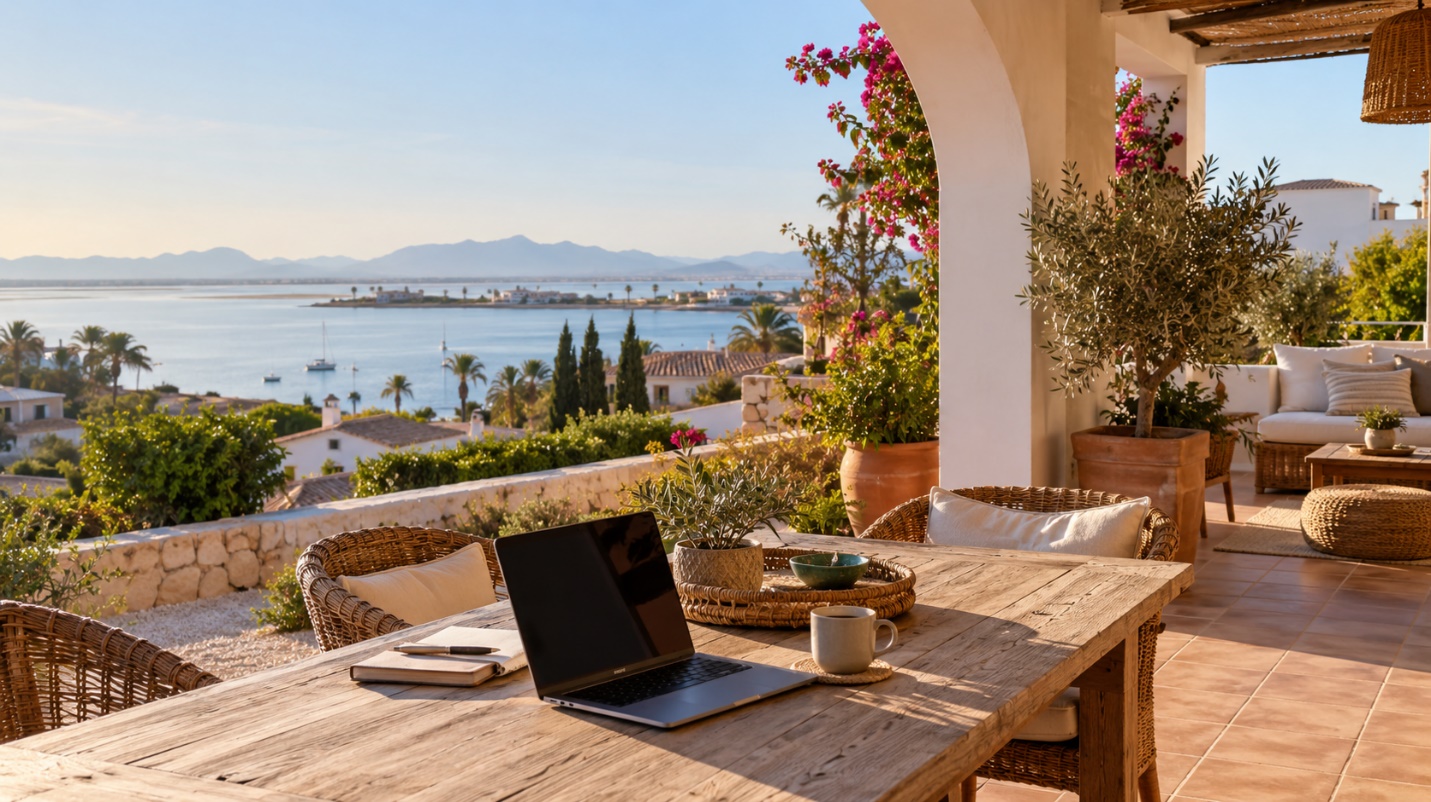
Alicante or Murcia for your remote-work life?
Alicante makes sense for professionals who value airport connections, city amenities, established international communities and easy access to a broad Costa Blanca property market.
Murcia suits people who want more space, lower regional housing costs, quieter coastal living or a home where the working environment matters as much as the nightlife outside it.
Neither choice should start with the cheapest property.
Start with your working week.
Where will you sit?
When will you travel?
How often will you return to Britain?
What do you want to do after closing the laptop?
Once you know those answers, your Spanish property search becomes much easier.
Working remotely and thinking about moving from the UK to Spain? Tell us how you want to live and work, and we will help you explore properties and locations across Alicante and Murcia that fit both.